Overview
Shufti's Individual AML Screening checks a person against 4,000+ global watchlists spanning 240+ countries and territories, covering sanctions, Politically Exposed Persons (PEPs), warnings and regulatory enforcement, fitness and probity, adverse media, and insolvency records. It helps you meet regulatory obligations and keep money launderers, blocklisted individuals, and other high-risk actors out of your business.
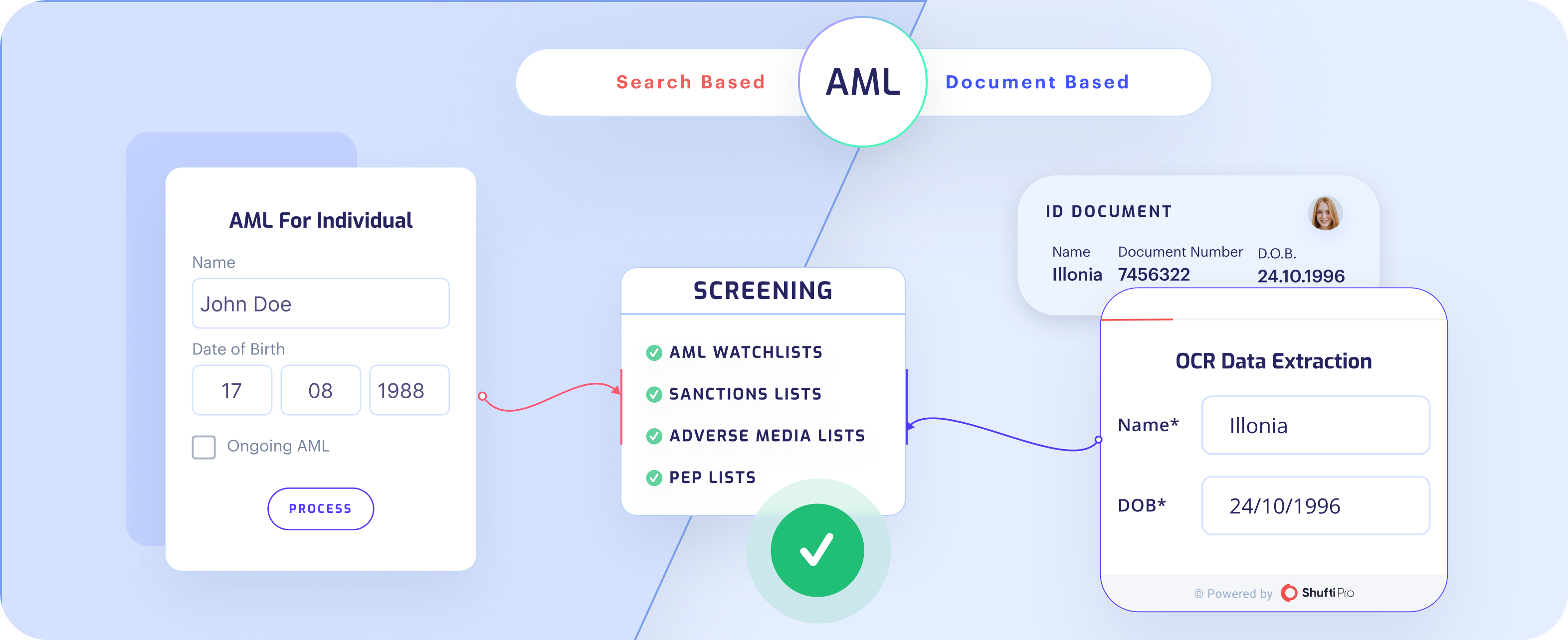
This page orients you to the product. If you want to integrate right away, jump to Onsite Integration or Offsite Integration.
What you can do
- Screen by name and date of birth against global sanctions, PEP, watchlist, and adverse media sources.
- Tune the search with country filters, unique identifiers, aliases, relatives and close associates (RCA), and a configurable match threshold.
- Add biometric and contextual signals by passing a face image and a context object to improve match accuracy.
- Keep records current with ongoing monitoring that re-screens active profiles and alerts you when a watchlist status changes.
- Resolve results in one place using the AI Compliance Co-Pilot, a Custom Risk Scoring Engine, and a built-in case management workflow.
How a screening works, in brief
- Input: You provide the person's name (required) and, ideally, date of birth. Data can be entered directly or extracted from a document via OCR.
- Search: The engine matches the input against your selected data sources using phonetic, alias, transliteration, and cultural name-variation logic.
- Score: Every returned record gets an AML Match Score from 0-100%. Records below your threshold are suppressed.
- Decide: Matches are returned in the response with full record detail. You accept, decline, or route them for review.
- Monitor (optional): Enrolled profiles are re-screened continuously, and you are alerted on any change.
For the full logic, data sources, and worked examples, see How It Works.
Two ways to integrate
Shufti exposes AML screening through the same background_checks service, in two integration modes:
| Mode | Who collects the data | Use when |
|---|---|---|
| Onsite | Shufti's hosted screen collects the end user's details | You want Shufti to manage the end-user interaction |
| Offsite | You send the details directly via API | You already hold the user's data and want a server-to-server check |
Both modes accept the same screening parameters and return the same response structure.
Documentation in this section
| Page | What it covers |
|---|---|
| Overview | Product orientation, screening flow summary, and integration modes |
| How It Works | Search modes, data sources, the matching engine, match score, ongoing monitoring, and compliance tooling |
| Onsite Integration | Request parameters and sample for the hosted flow |
| Offsite Integration | Request parameters and sample for the API-only flow |
| Match Results | Reference for the match-type values returned on each hit |
| Responses | Structure of the verification response and the AML data object |
| Declined Reasons | Status codes returned when a screening is declined |